
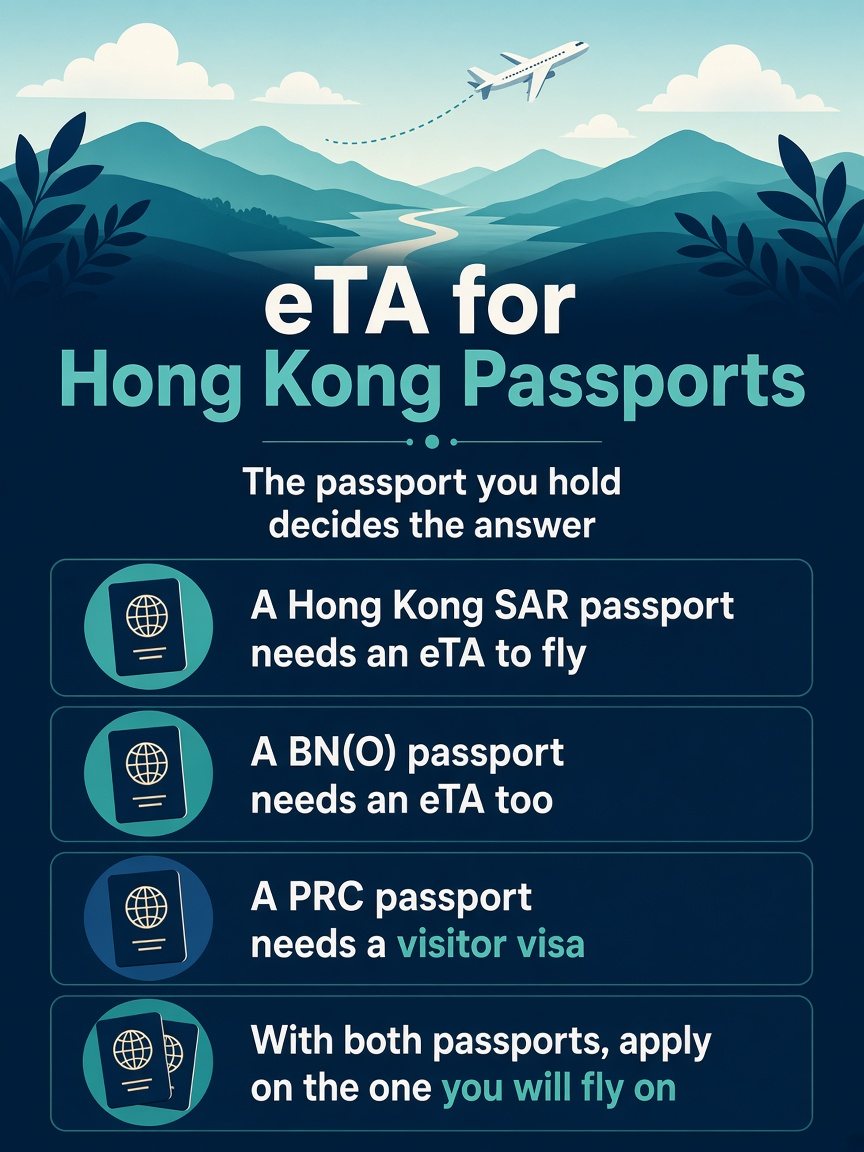
The short answer: in Hong Kong the passport in your hand decides everything. A Hong Kong SAR passport and a British National (Overseas) passport both need an eTA to board a flight to Canada, while a passport of the People’s Republic of China needs a visitor visa.
Filing through the government’s own site costs only the fee. Below, each Hong Kong-related document is matched to what Canada asks for.
Hong Kong is easy to overlook, because it sits under H and not under C in the list of eTA countries, and many travellers assume that anything Chinese means a visa. The short version of that list is in our guide to every eTA-eligible country; what follows is the Hong Kong detail the list has no room for.
Which passport do you hold, and what does Canada ask for?
Canada sorts travellers by citizenship and nationality and by the document they carry, not by the city they live in. For people connected to Hong Kong that produces three different answers:
| Document you travel on | What you need to fly to Canada |
|---|---|
| Hong Kong SAR passport | An eTA |
| British National (Overseas), or BN(O), passport | An eTA |
| A PRC passport (People’s Republic of China) | A visitor visa; an eTA does not replace it |
| Both an HKSAR and a BN(O) passport | An eTA on whichever one you will use for the trip |
| Canadian passport (you are a Canadian citizen) | Neither; fly on the Canadian passport |
The Hong Kong entry carries a condition: the passport has to be one issued by the Hong Kong SAR. The BN(O) is not a variation of it. Canada lists British national overseas as its own line in the eTA group, next to British citizen and the other British categories, so the two documents are handled separately even when the same person holds both.
Why does a Chinese passport lead to a visa?
Canada keeps “China, People’s Republic of” on its list of visa-required countries. That list is about the passport, so living in Hong Kong does not move a PRC passport into the eTA group. If the PRC passport is the only one you intend to travel on, you apply for a visitor visa.
There is one narrow exception for people who only change planes. Canada’s list of cases that need neither a visa nor an eTA includes passengers transiting a Canadian airport under the Transit Without a Visa program or the China Transit program. Those programs have their own conditions, so check them before you count on a layover without a visa; the wider picture is in our guide to layover rules between Canada and the US.
What do you pick in the form for HKSAR and BN(O)?
The official eTA form opens with a question about your travel document, then asks for the code that matches your passport and the nationality noted on it. Both answers come from the passport information page, from whichever line your passport labels Code, Issuing country, Authority or Country code. The country list is not a plain list of states. China is split into three entries, one of which reads China (Hong Kong SAR), and the British entries are split by nationality class, one of which is GBN (Brit. Ntl. Overseas). Choose the entry that matches the page in your own passport, and do not pick the neighbouring line because it looks similar.
This detail is worth a minute, because the country list never screens anyone out; it takes whatever you select. A mistaken number or code can stop you boarding, and the problem may surface only at the airport. The full list of codes, with the unusual ones, is in the passport country code guide.
You hold an HKSAR and a BN(O) passport: which one gets the eTA?
Many people from Hong Kong carry both, and both are eligible, so the choice is practical rather than legal. The eTA is attached to the passport named in the application, and that is the passport you present at check-in. Airline staff scan it to confirm a valid eTA exists, and without one you cannot board.
That gives a simple rule: decide which passport you will fly on, apply with it, and keep to it for the trip. An eTA on the HKSAR passport does nothing for a traveller who shows the BN(O) passport at the counter, and the reverse is true as well. If you want to be free to use either, each passport needs its own eTA. An eTA stays with a single passport number, which also means a renewed passport needs a new eTA.
Copy the passport number exactly. After you apply, check that the number in the approval email matches your passport; if it differs, you must submit a new application with the right number.
Do Hong Kong travellers need an eTA when arriving by road, rail or sea?
Only for flights. Canada says that a citizen of an eTA country who arrives overland or by water (cruise ships too) usually needs no eTA, though a valid passport is still required. One sea case differs: a boat leaving Saint-Pierre-et-Miquelon, cruise ships excepted, does call for an eTA.
In practice a Hong Kong passport holder reaching Canada from the United States by land, or joining a cruise, does not go through the eTA at all, while the same traveller who books a flight does. A PRC passport is different, since a visitor visa is required whatever the route.
What about Hong Kong residents who are Canadian citizens or permanent residents?
Plenty of people in Hong Kong have a second status linked to Canada, and neither one needs an eTA.
- Canadian citizens. A dual Canadian citizen must travel with a valid Canadian passport. Showing the HKSAR or BN(O) passport instead is the wrong move, and the eTA form is not meant for citizens.
- Permanent residents. A permanent resident is exempt from both an eTA and a visa, and carries a valid PR card or a PR travel document. That status does not lapse by itself, so someone who lived in Canada long ago may still hold it.
If you are unsure which of the two describes you, settle that before applying for anything.
How long a visit does an eTA allow?
The eTA lets you board; the border services officer decides on arrival. You must convince the officer that you meet the entry requirements, including ties that will take you back home and a plan to leave Canada at the end of the visit. Most visitors may stay up to six months. The officer can shorten or extend the stay and writes the date you need to leave in your passport, and without a stamp the six months run from the day you entered or until the passport expires, whichever date is earlier. An eTA never guarantees entry.
Whatever you carry, a valid passport has to be in your hand. The same list of requirements covers good health, no criminal or immigration-related convictions, and enough money for the stay.
How the application works
Have ready a passport that is still valid, a payment card and an email address, then answer the questions one traveller at a time. Each person applies on their own passport. Many decisions come back within minutes. Some requests need several days; in that case Canada sends an email with your next steps within 72 hours of applying, and that email is not the decision itself. Check your junk folder, since automated messages can be filtered out.
Later on, you can look up your eTA status; the lookup asks for your passport plus the application number or UCI. Canada says no special document has to be printed; your passport is what the airline scans.
For the lists behind this page, the page on what you need to enter Canada is worth rereading again before booking, as lists get updated.
The short version
- A Hong Kong SAR passport and a BN(O) passport both need an eTA for flights to Canada.
- A Chinese (PRC) passport needs a visitor visa; an eTA does not replace it.
- Where you live does not change the answer; the passport you travel on does.
- With both HKSAR and BN(O) passports, apply on the one you will fly on, because the eTA is tied to that passport.
- Pick the form entry that matches your passport: China (Hong Kong SAR) or GBN (Brit. Ntl. Overseas).
- Driving in or coming by rail, coach or ship usually needs no eTA; Canadian citizens and permanent residents never need one.
FAQ
Is a visa required to visit Canada on a Hong Kong SAR passport? No. Canada lists Hong Kong SAR in the eTA group, so you need an eTA to fly, not a visitor visa. The passport must be one issued by the Hong Kong SAR.
Is a BN(O) passport treated like a Hong Kong passport? It leads to the same document, an eTA, but it is a separate entry on Canada’s list, under British national overseas. In the form you choose the matching British entry, GBN, and not the Hong Kong one.
Can I use my Chinese passport if I live in Hong Kong? Not for an eTA. A PRC passport belongs to the visa-required group, and the list follows the passport, not your address. If you also hold an HKSAR or BN(O) passport, you can apply for an eTA on that one and fly with it.
I have both an HKSAR and a BN(O) passport. Do I need two eTAs? One is enough if you travel on one passport throughout. The eTA is tied to the passport named in the application, so show that same passport at check-in. Applying on both only makes sense if you want to be able to use either.
Do I need an eTA if I drive into Canada? Usually not, for an eTA country. Arriving overland or by water does not call for one, though you still need a valid passport. A PRC passport holder still needs a visitor visa.